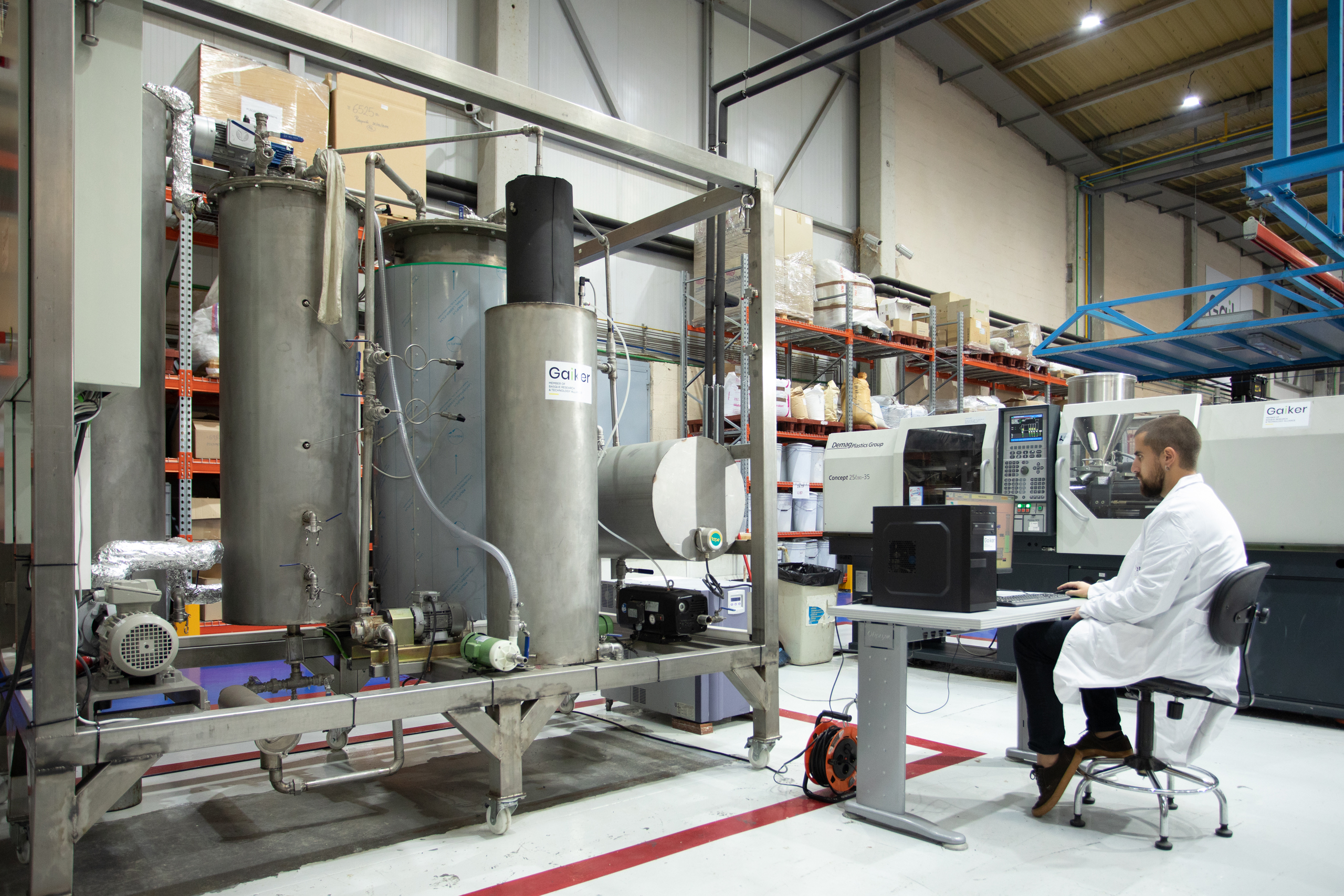
The BIRPLAST project devoted to obtaining circular raw materials from plastic waste by applying intelligent separation and chemical recycling technologies has come to an end
The BIRPLAST project, in which GAIKER, a member of the Basque Research & Technology Alliance, BRTA, has participated, along with three other actors of the Basque Science, Technology and Innovation Network, has come to an end this year. This research, led by the Sener Engineering and Technology Group, has enabled ten companies to join forces to carry out R&D in new technologies for the separation and chemical recycling of plastic waste to ensure the production of high quality circular raw materials.
BIRPLAST was launched in 2022 with the aim of generating a knowledge base to develop improved recycling processes in the eco-industry for various complex plastic waste streams – streams generated mainly during the treatment of other waste, such as light packaging, end-of-life vehicles (ELVs) or waste electrical and electronic equipment (WEEE) – as the current state of the art does not allow the full potential of these resources and raw materials to be harnessed.
The project has drawn to a close with significant results related to advanced separation. In the case of light packaging waste, an improved material sorting step has been defined to match the composition of plastic fractions of limited recyclability and rejection, supported by the application of spectroscopic and data analysis techniques based on machine learning. Work has also been carried out on the use of plastic waste with some traces of metal from car shredders by means of smart separation techniques.
New pyrolysis processes have been developed for the chemical recycling of waste. One treats mixed plastics in which the waxes generated are reprocessed to offer lighter and more valuable products while reducing their chlorine content. The other processes plastics with biomass and obtains oils with low halogen content. New solvolysis processes have also been developed to recycle polyesters and polyurethane foams from car shredding. Gasification processes have also been adapted to work with different types of waste and with different degrees of humidity, using fluidised bed and jet spouted bed reactors to obtain and purify synthesis gas. Finally, the treatment of water generated during the pyrolysis and gasification processes and the use of pyrolysis oils as wood protection actors have also been defined.
Furthermore, for each result, such as smart separation processes or monomers, chemicals or oils obtained by solvolysis or pyrolysis, production efficiency and the contribution to the circular economy has been measured and the environmental assessment has been completed to determine the improvement resulting from the generation of these circular raw materials compared to the existing management of plastic waste that is not used.
BIRPLAST, which has been successfully completed and has fulfilled the objectives set, is a strategic industrial research project that has received funding from the HAZITEK 2022 programme (Exp. ZE-2022/00022), a programme to support the business R&D of the Basque Government's Department of Economic Development, Sustainability and the Environment.