The aim of the VALON project is to recover plastic waste that is rich in brominated flame retardants, which comes from processing and recycling waste electrical and electronic equipment, in order to obtain high-value secondary raw materials.
The GAIKER Technology Centre, a member of the Basque Research & Technology Alliance (BRTA), is taking part in the VALON project, the main aim of which is to add value to plastic waste that is rich in brominated flame retardants (BFRs), which comes from the industrial processing and recycling of waste electrical and electronic equipment (WEEE). This initiative focuses on concentrating and recovering the antimony (Sb) present in this waste and transforming it into a secondary raw material.
The European Union has included antimony on its list of critical raw materials, due to its strategic importance for various industrial sectors. European legislation aims to increase the annual supply of these materials by promoting the recycling of the waste that contains them, amongst other measures. To this end, VALON proposes investigating technological solutions aimed at recovering antimony from the plastics waste in WEEE that is rich in brominated flame retardants for use in industry.
The project, which will come to an end in December, will focus on studying and evaluating various recovery methods based on a combination of optical identification and automatic sorting technologies, together with separation methods based on physical properties, with the aim of obtaining plastic fractions with a high antimony content. Beneficiation, hydrometallurgical extraction and antimony recovery techniques will be applied to antimony-enriched fractions.
As part of the VALON project, GAIKER’s work focuses on conducting laboratory research:
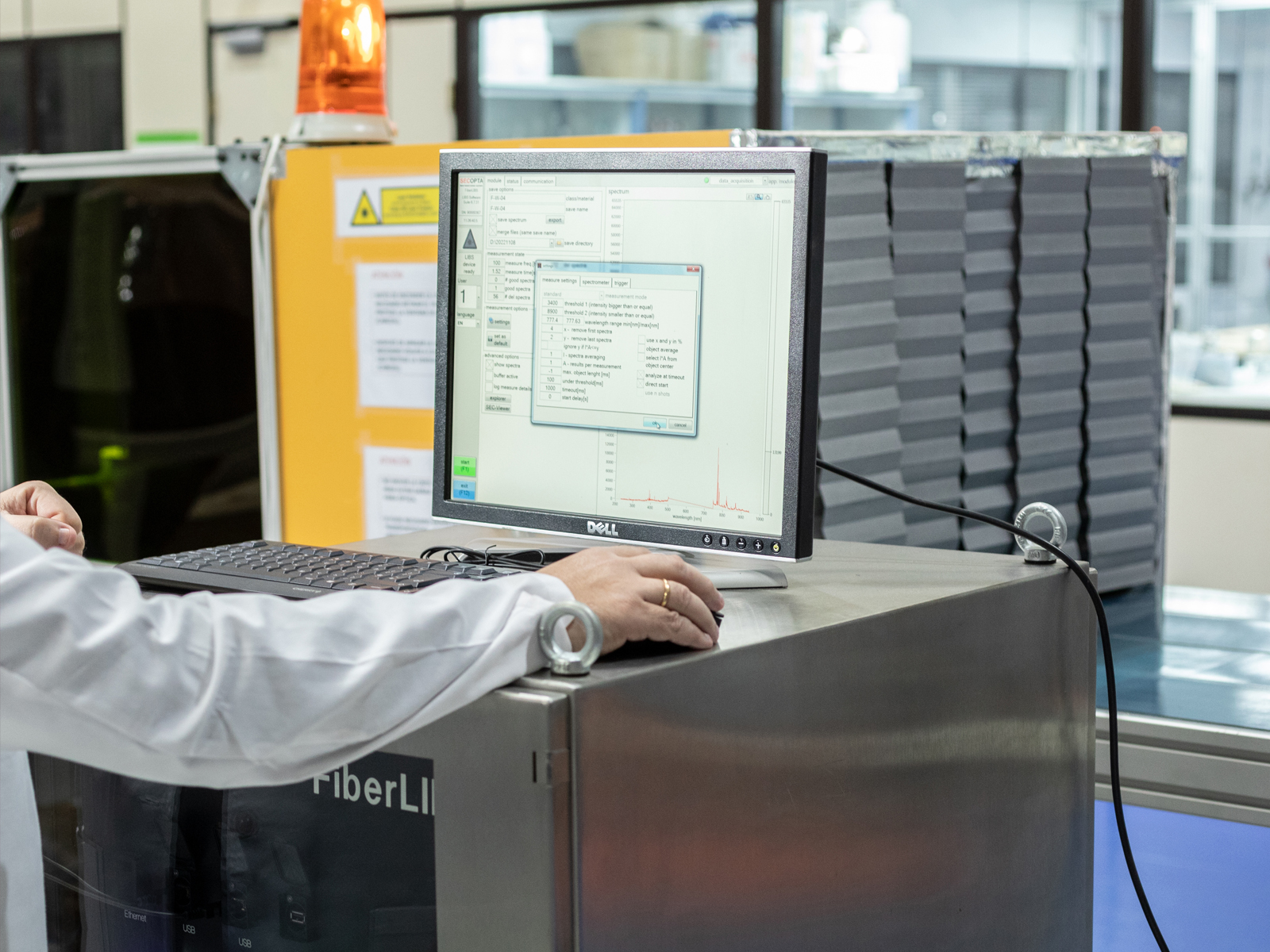
- The efficiency of LIBS spectroscopy combined with multivariate data analysis models to automatically classify the stream of brominated plastic waste from WEEE and obtain a new, antimony-enriched fraction.
- The efficiency of separation processes (sink-float and froth flotation) based on the physical properties of plastics, with the aim of obtaining new fractions enriched in antimony and segregated by polymer type.
- Thermal conditioning processes (pyrolysis) and hydrometallurgical extraction of antimony applied to antimony-concentrated plastic fractions.
The VALON project is coordinated by the Inatec Foundation and funded by the Basque Government (Record No.: KK-2025/00057) through the ELKARTEK 2025 aid programme for collaborative research in strategic areas.

Subsidised by the Basque Government